

Field Maintenance of M83513: How to Quickly Replace Contacts?
Field Maintenance of M83513: How to Quickly Replace Contacts? Our
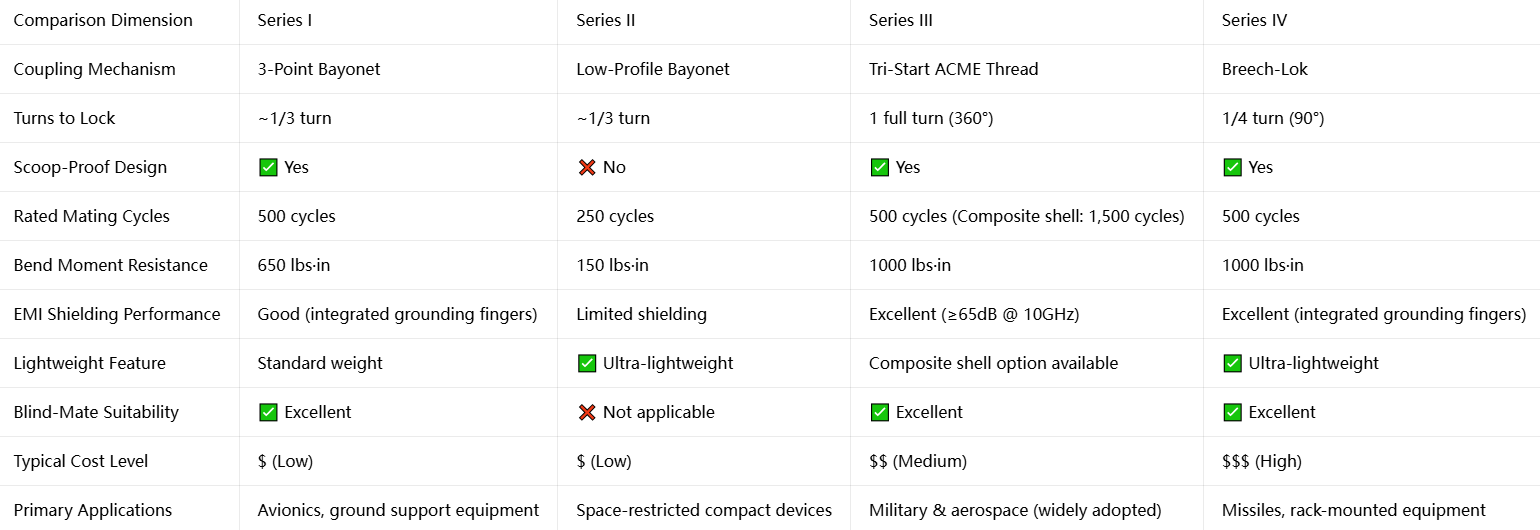
One Chart to Understand the Four Series of MIL-DTL-38999: Core Differences and Selection Guide for Series I/II/III/IV
The “Standard Answer” for Military Connectors
In the world of military circular connectors, MIL-DTL-38999 is a name you cannot avoid. Born in the 1970s as MIL-C-38999, it was developed to meet the trend toward “more signal, less power” in military avionics at the time. After decades of evolution, it has become one of the most popular and widely used connector standards in global military aviation, aerospace, and demanding industrial applications.
The MIL-DTL-38999 standard defines four distinct series: Series I, Series II, Series III, and Series IV. They share the same core specifications — environmental resistance, removable crimp contacts, and an operating temperature range of -65°C to +200°C — but they are not interchangeable or intermateable with each other.
This article uses a clear comparison chart to help you understand the coupling mechanism, scoop-proof design, mating cycles, vibration resistance, and application scenarios of all four series at a glance, and provides practical selection guidance.
MIL-DTL-38999 Standard Overview
MIL-DTL-38999 (formerly MIL-C-38999) is a military specification that defines miniature, high-density, circular connectors, available in bayonet and threaded coupling types. It features removable crimp contacts and an operating temperature range of -65°C to +200°C.
The standard defines four different connector series. All of them feature high contact density, supporting up to 128 contacts; are available in 9 shell sizes (9 through 25); and support a wide variety of contact types, including signal, power, coaxial, twinax, quadrax, and fiber optic.
The core differences among the four series lie in their coupling mechanisms, scoop-proof design, and optimization priorities — each is detailed below.
Series I — The Classic Choice for Bayonet Coupling
Coupling Mechanism: 3-Point Bayonet Coupling
Series I features 3-point bayonet coupling. Three bayonet pins on the plug mate with three slots on the receptacle, locking with approximately one-third of a turn. Bayonet coupling is characterized by quick disconnect, making it suitable for blind-mating areas that require frequent mating and unmating.
Key Features:
100% Scoop-Proof: Pins are recessed within elongated shells, preventing contact damage even if the plug is inserted at an angle
High Vibration Resistance: Suitable for high-wind and moisture environments
5-Key/Keyway Polarization: 5 positioning options eliminate misinsertion risk
Grounding Fingers: Provide standard EMI shielding
Mating Cycles: 500
Typical Applications: Avionics systems, flight-critical electronics, defense and weapon systems, ground support equipment
Series II — The Low-Profile Choice for Lightweighting
Coupling Mechanism: Low-Profile Bayonet Coupling
Series II also uses bayonet coupling, but with a lower profile and lighter weight. To achieve its reduced height and weight, Series II is not scoop-proof.
Key Features:
Not Scoop-Proof: Pins are exposed, requiring careful alignment during blind mating
Low-Profile Design: Reduced shell height saves panel space
Lightweight: Lighter than standard Series I
Rear-Release Crimp Contacts: Removable from the rear for easy maintenance
Mating Cycles: 250
Typical Applications: Space- and weight-sensitive applications — avionics, medical technology, communication equipment. Performs well in low-vibration, high-moisture environments.
Important: Due to its lack of scoop-proof protection, Series II is not suitable for blind-mating applications. For applications requiring blind mating, choose Series I, III, or IV.
Series III — The High-Performance King of Tri-Start Thread
Coupling Mechanism: Tri-Start ACME Thread
Series III is the highest-performance series in the 38999 family, designed for general-purpose and severe-environment applications. It features Tri-Start ACME Thread coupling, locking completely with one full turn (360°) .
Key Features:
100% Scoop-Proof: Pins are protected
Self-Locking Thread: Coupling nut features an anti-decoupling ratchet — no lockwire required
Extremely High Vibration Resistance: Suitable for high-temperature, high-moisture, high-wind, and high-vibration environments
EMI Shielding ≥65dB @ 10GHz
Mating Cycles: 500
Composite Shell Option: Up to 40% lighter than aluminum, 4x better corrosion resistance, and 1,500 mating cycles
Fiber Optic Contacts Supported
Typical Applications: Series III is the most commonly used choice in military and aerospace designs. Widely used in fighter avionics, missile systems, satellites, engine compartments, and other harsh environments.
Series IV — The Rugged Choice for Breech-Lok Coupling
Coupling Mechanism: Breech-Lok (Quarter-Turn)
Series IV features Breech-Lok coupling, inspired by artillery breech locking mechanisms. After insertion, the plug locks with a quarter-turn (approximately 90°) .
Key Features:
100% Scoop-Proof: Pins are protected
Visual + Tactile + Audible Triple Mating Confirmation
Primary + Secondary Dual Locking Mechanism
Extremely High Vibration Resistance: Outperforms threaded connectors in high-vibration environments
Lightweight Design
Suitable for Blind-Mating Applications
Mating Cycles: 500
Typical Applications: Rack and panel equipment, missile systems, aerospace. Suitable for applications requiring robust locking and extreme vibration resistance. Particularly well-suited for Line Replaceable Units (LRUs) requiring quick disconnect.
Core Parameter Comparison Table of the Four Series
Selection Guide — Four Questions to Lock In the Right Answer
Q1: Is blind mating required?
Q2: Is the application in a high-vibration environment?
Q3: Are space and weight extremely limited?
Q4: Is the highest level of EMI shielding required?
Final Recommendation:
When there are no special restrictions, choose Series III — it is the most comprehensive and widely used series in the 38999 family.
If space and weight are the primary constraints and blind mating is not required → Series II
If extremely quick mating and robust locking are required (e.g., battlefield LRUs) → Series IV
Four Series, Configured to Your Needs
Every one of the four series described above — our product line covers all of them,
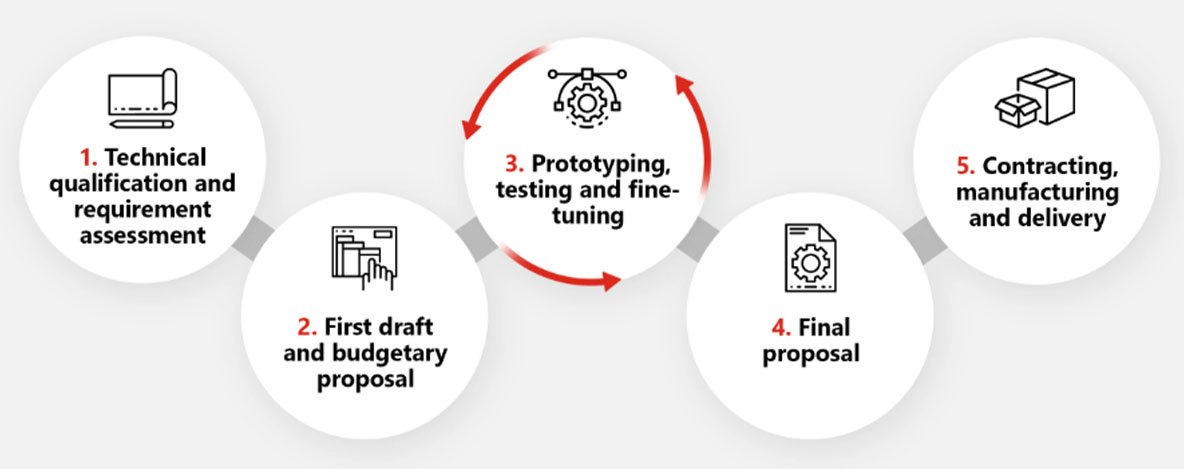
We deliver not just connectors — but a one-stop solution of “four-series precision matching + European compliance”
Recent Posta
Field Maintenance of M83513: How to Quickly Replace Contacts? Our

38999 vs MIL-C-83513: Circular vs Micro-Rectangular Our Products Two Shapes,

Salt Spray Resistance of MIL-C-26482: A Complete Guide to Plating
Get Quote of Connectors