

Field Maintenance of M83513: How to Quickly Replace Contacts?
Field Maintenance of M83513: How to Quickly Replace Contacts? Our
5,000 Mating Cycles, IP68, 360° Shielding — Where Are the Performance Limits of Push-Pull Connectors?
Three Numbers That Define a Connector’s “Limits”
In the specification sheets of military connectors, three numbers appear frequently: 5,000 mating cycles, IP68, and 360° shielding. They represent the connector’s durability, environmental adaptability, and signal integrity — three critical dimensions that determine whether a connector can work reliably on the battlefield.
These three numbers are not marketing slogans, but performance limits validated through rigorous testing. This article explores these three dimensions to help you fully understand the performance ceiling of push-pull connectors.
5,000 Mating Cycles — The Limit of Durability
1.1 What Does 5,000 Cycles Mean?
5,000 mating cycles is the industry benchmark for the durability of military push-pull connectors. Many high-quality push-pull connectors achieve or exceed this number.
To understand the significance of this number, here is a simple calculation:
If a soldier mates/unmates a connector 2 times per day, 5,000 cycles would last 6.8 years
If mated/unmated 10 times per week, 5,000 cycles would last nearly 10 years
In frequently mated/unmated Line Replaceable Units (LRUs), 5,000 cycles are sufficient to cover the full lifecycle of most equipment
In comparison, standard threaded or bayonet connectors typically offer only 500 mating cycles. The push-pull connector’s 5,000-cycle life is 10 times that of its counterparts.
1.2 How Is 5,000 Cycles Achieved?
The 5,000-cycle mating life does not come from nowhere; it relies on the following design features:
1.3 The Battlefield Value of 5,000 Cycles
In frequently mated/unmated battlefield scenarios, 5,000 mating cycles mean:
Reduced battlefield maintenance frequency: Connectors will not prematurely fail due to mating wear
Reduced spare parts inventory pressure: No need to stock large quantities of spare connectors for frequent replacement
Supports modular design: Line Replaceable Units (LRUs) can be repeatedly installed and removed without concern for connector failure
Full lifecycle coverage: From deployment to retirement, a single connector can cover the entire service life
IP68 — The Limit of Environmental Sealing
2.1 What Does IP68 Mean?
IP (Ingress Protection) rating is the international standard for measuring a connector’s dust and water resistance. IP68 is one of the highest dust and water resistance ratings available.
6 (Dust protection) : Complete protection against dust ingress — dust-tight
8 (Water protection) : Continuous immersion under specified conditions — continuous immersion protection
IP68 specifically means: the connector can be continuously immersed at the depth and duration specified by the manufacturer without water ingress. Different products have different IP68 test conditions — some may be 1 meter / 24 hours, others 20 meters / 2 hours.
2.2 The IP68 “Bonus” of Military Push-Pull Connectors
IP68 Sealing Even When Unmated:
Ordinary connectors’ IP68 sealing is only effective in the mated condition — once unmated, the seal is lost. But some high-quality military push-pull connectors achieve IP68 sealing even in the unmated condition.
This means that even when soldiers open the connector in the rain, moisture cannot penetrate into the interior. The protection performance remains consistent whether the connector is mated or unmated.
Wide Temperature Range:
Military push-pull connectors typically operate across -55°C to +125°C, with some reaching -55°C to +200°C. In the extreme cold of the Arctic and the extreme heat of the desert, sealing performance remains reliable.
Salt Spray Resistance:
Beyond waterproofing, military push-pull connectors also offer 500 to 1,000+ hours of salt spray resistance. In shipboard and coastal environments, this capability is critical.
2.3 The Battlefield Value of IP68
Rainy operations without worry: Even if connectors are exposed to heavy rain, internal signals are not affected by water
Water crossing / immersion scenarios: In river crossings, amphibious landings, etc., connectors can remain operational underwater
Shipboard / coastal environments: Connectors will not be corroded in high-salt environments
Sand / mud environments: Completely dust-tight, sand and dust cannot enter the connector interior
360° Shielding — The Limit of Signal Integrity
3.1 What Does 360° Shielding Mean?
In the modern battlefield electromagnetic environment, EMI/RFI (Electromagnetic Interference / Radio Frequency Interference) is everywhere — from friendly radar and communication equipment to enemy electronic jamming. 360° shielding means the connector provides electromagnetic protection in all directions.
Unlike connectors that only offer shielding in select directions, 360° shielding delivers all-round electromagnetic protection through a combination of metal housings, ground springs and shielding termination bands.
3.2 How Is 360° Shielding Achieved?
3.3 The Battlefield Value of 360° Shielding
Protecting sensitive signals: Ensuring signals are not interfered with or leaked in high-EMI environments
Preventing crosstalk: Preventing mutual interference between adjacent signals in high-density signal transmission
Supporting high-speed data: 360° shielding is a prerequisite for 10Gbps high-speed data transmission
Resisting electronic warfare environments: Maintaining normal operation of communications and sensors under enemy electronic jamming
How Do the Three Limits Work Together?
5,000 mating cycles, IP68, and 360° shielding — these three performance limits are not isolated, but mutually supportive and work together.
Together, the three form the performance iron triangle of push-pull connectors — none can be missing, each supports the others.
Battlefield Applications of Performance Limits
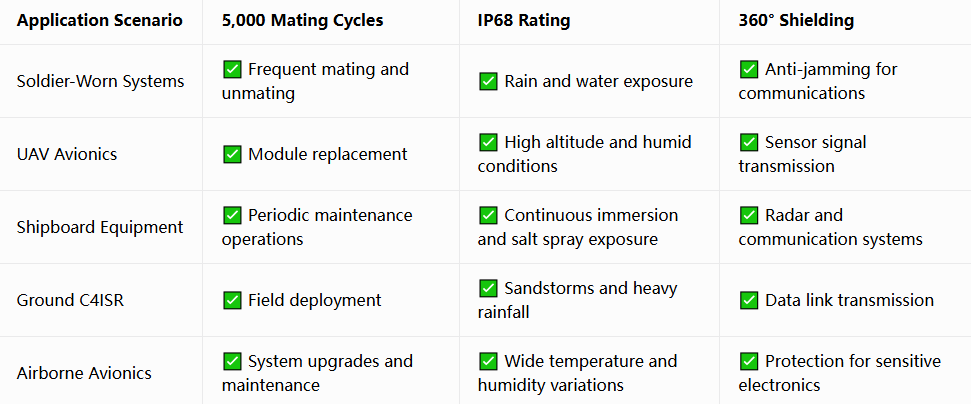
Three Numbers, One Standard
5,000 mating cycles, IP68, and 360° shielding — these three numbers define the performance limits of military push-pull connectors. They are not isolated metrics, but a complete performance system: durability allows repeated use, sealing allows use in any environment, and shielding allows use in any electromagnetic environment.
When a connector simultaneously reaches all three limits, it is no longer just a connector — it is an interconnection solution that can work reliably under the most demanding battlefield conditions.
This is the performance limit of push-pull connectors — and the fundamental reason they have become the “quick-connect choice” in the military domain.
5,000 mating cycles, IP68, and 360° shielding — these three performance limits are fully delivered by our product line, and all are available with RoHS-compliant plating options (Black Zinc Nickel / Electroless Nickel), ensuring your equipment enters the European market smoothly.
Submit your five-step requirements | Receive selection advice + compliance document templates within 24 hours
Recent Posta
Field Maintenance of M83513: How to Quickly Replace Contacts? Our

38999 vs MIL-C-83513: Circular vs Micro-Rectangular Our Products Two Shapes,

Salt Spray Resistance of MIL-C-26482: A Complete Guide to Plating
Get Quote of Connectors