

Field Maintenance of M83513: How to Quickly Replace Contacts?
Field Maintenance of M83513: How to Quickly Replace Contacts? Our
Coaxial Contact vs Quadrax Contact: How to Choose the High-Speed Data Transmission Solution for 38999?
When Connectors Are No Longer Just About “Connecting”
They look similar — both feature shielded structures and occupy specific size cavities within the 38999 shell. But their internal structures, electrical characteristics, applicable protocols, and selection logic are fundamentally different. This article clarifies the differences between these two contacts from three dimensions — structure, performance, and application — and provides clear selection guidance.
In traditional military connector applications, the task of contacts was relatively simple: transmit power or low-frequency signals. But today’s battlefield is completely different — UAVs streaming high-definition video in real time, fighter avionics exchanging massive sensor data, missile guidance systems processing high-precision radar signals. These scenarios have upgraded the requirements for connectors from “reliable on/off” to “high speed, high bandwidth, and low loss.”
MIL-DTL-38999 connectors address this challenge by offering multiple high-speed contact options. The two most commonly used among them are: Coaxial Contact and Quadrax Contact.
Coaxial Contact — The “Dedicated Channel” for High-Speed RF Signals
1.1 What Is a Coaxial Contact?
Coaxial contact is the most classic high-speed contact type. Its structure is very simple: a center conductor (pin or socket), surrounded by an insulating material, with an outer shielding layer (outer conductor) wrapped around it. The center conductor carries the signal, and the outer conductor provides shielding and grounding.
In MIL-DTL-38999 connectors, coaxial contacts are typically available in sizes #8, #12, and #16 . They are installed in standard 38999 shell cavities and can be mixed with signal and power contacts.
1.2 Core Performance Parameters
The performance of a coaxial contact is determined by its impedance and frequency range.
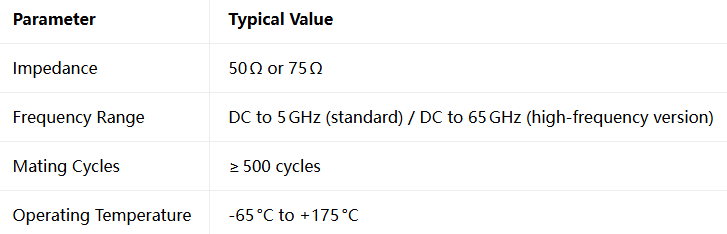
A key characteristic of coaxial contacts is single-ended signal transmission — one contact carries one signal, referenced to ground.
1.3 Typical Applications
Quadrax Contact — The High-Speed “Data Pipeline” for Differential Signals
2.1 What Is a Quadrax Contact?
Quadrax contact is a contact type specifically designed for high-speed differential signal transmission. Its structure is much more complex than that of a coaxial contact:
One outer shell + four inner contacts
The four inner contacts are precisely spaced to form two differential pairs. Each differential pair consists of two wires — one carrying the positive signal (+), the other carrying the negative signal (-), with the signal referenced to the voltage difference between the two wires.
This structure gives the Quadrax contact two independent differential signal channels within a single #8 cavity.
2.2 Core Performance Parameters
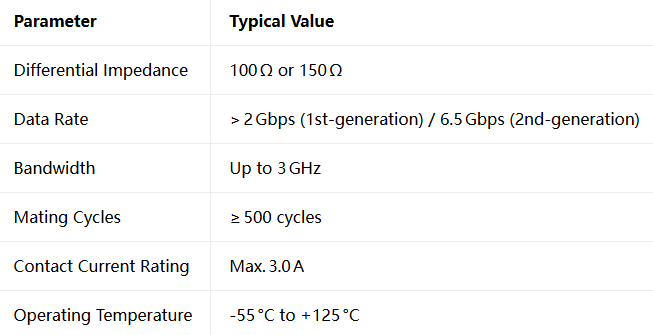
Quadrax contacts use differential signal transmission — one differential pair carries one signal, referenced to the voltage difference between the two wires. This transmission method offers stronger noise immunity and lower electromagnetic radiation.
2.3 Typical Applications
Coaxial vs Quadrax — Six-Dimensional Comprehensive Comparison
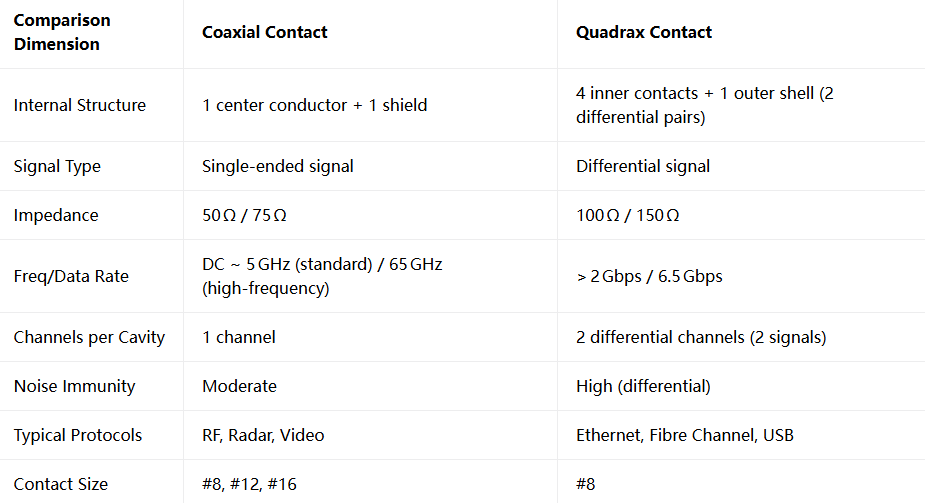
Selection Decision — Four Questions to Help You Choose
In actual selection, answer these four questions in order:
Q1: Are you transmitting RF/analog signals or high-speed digital data?
RF signals (radar, antenna, communications) → Coaxial Contact
High-speed digital data (Ethernet, video streaming, sensor data) → Move to next question
Q2: Is the data rate above 1 Gbps?
Yes → Quadrax Contact (supports >2 Gbps to 6.5 Gbps)
No (<1 Gbps) → Coaxial may be sufficient
Q3: Does the system require differential or single-ended signals?
Differential (high noise immunity, long-distance transmission) → Quadrax Contact
Single-ended (cost-sensitive, short distance) → Coaxial Contact
Q4: Is contact density critical?
Yes (need to transmit more signals in limited space) → Quadrax Contact (one #8 cavity provides 2 differential channels)
No → Coaxial is sufficient
Selection Quick Reference
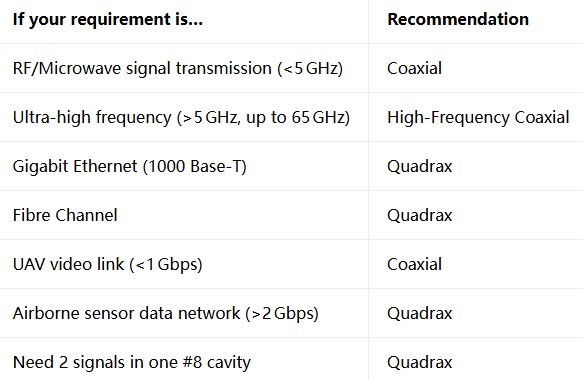
Choosing the Right Contact Means Choosing the Right Data Channel
Coaxial and Quadrax contacts are not about “which is better,” but about “which is more suitable.”
Coaxial contact is the gold standard for RF and analog signals — simple, reliable, and wide frequency coverage. If your system needs to transmit radar signals, antenna feeds, or video signals, coaxial contact is the proven choice.
Quadrax contact is the dedicated channel for high-speed digital data — one cavity provides two differential channels, supporting Gigabit Ethernet, Fibre Channel, and other high-speed protocols. If your system needs to transmit large volumes of digital data in harsh environments, Quadrax is the solution designed specifically for that purpose.
When selecting, ask yourself three questions: What signal are you transmitting? How fast? How far? The answers will guide you to the right choice.
Coaxial and Quadrax, Configured to Your Needs
Every high-speed contact described above — Coaxial and Quadrax — our product line covers all of them
Submit your signal type and data rate requirements | Receive selection advice
Recent Posta
Field Maintenance of M83513: How to Quickly Replace Contacts? Our

38999 vs MIL-C-83513: Circular vs Micro-Rectangular Our Products Two Shapes,

Salt Spray Resistance of MIL-C-26482: A Complete Guide to Plating
Get Quote of Connectors