

Field Maintenance of M83513: How to Quickly Replace Contacts?
Field Maintenance of M83513: How to Quickly Replace Contacts? Our
Salt Spray Resistance of MIL-C-26482: A Complete Guide to Plating Selection and Corrosion Resistance Levels
Salt Spray — The “Invisible Killer” of Connectors
In marine, coastal, and shipboard environments, salt spray is one of the most persistent and insidious threats to connectors.
Chloride ions in salt spray can penetrate the protective layer on metal surfaces, causing pitting, crevice corrosion, and galvanic corrosion.
For MIL-C-26482 connectors, salt spray resistance directly determines their service life in shipboard, coastal, and humid environments.
The core of salt spray resistance lies in plating selection.
This article provides a comprehensive explanation of MIL-C-26482 salt spray resistance from four dimensions: corrosion mechanisms, plating options, test standards, and selection guidelines.
Why Is Salt Spray So Deadly to Connectors?
Salt spray damages connectors through three main mechanisms:
1. Pitting Corrosion:
Chloride ions break down the passive film on metal surfaces, forming tiny corrosion pits locally.
Once pitting begins, it penetrates deeper into the metal, eventually causing shell perforation or contact failure.
2. Crevice Corrosion:
Salt spray tends to accumulate in crevices such as threads, sealing rings, and contact interfaces.
These areas have lower oxygen concentration, forming an oxygen concentration cell that accelerates localized corrosion.
3. Galvanic Corrosion:
When two metals with different potentials come into contact in a salt spray environment, the metal with the lower potential corrodes preferentially.
For example, when an aluminum alloy shell contacts a stainless steel screw, the aluminum alloy may corrode faster.Therefore, the salt spray resistance of MIL-C-26482 connectors depends on the combined effect of shell material, plating system, and sealing design.
Main Plating Options for MIL-C-26482
MIL-C-26482 connectors offer multiple plating options, each with different salt spray resistance.
1. Olive Drab Cadmium
Olive drab cadmium is a traditional military plating with excellent corrosion resistance.
The cadmium layer acts as a sacrificial anode, corroding preferentially in salt spray environments to protect the underlying aluminum alloy.Olive drab cadmium plating typically provides salt spray resistance of up to 500 hours.
However, cadmium is a toxic heavy metal and is not RoHS compliant.
2. Electroless Nickel
Electroless nickel is a RoHS-compliant plating option.
It provides uniform coating thickness, suitable for precision threads and complex geometries.Standard electroless nickel provides salt spray resistance of approximately 48 hours.
With special processes or increased plating thickness, salt spray resistance can be improved.
3. Black Zinc Nickel
Black zinc nickel is a zinc-nickel alloy plating and is RoHS compliant.
It offers excellent corrosion resistance, with salt spray resistance up to 500 hours.Black zinc nickel has an electrochemical potential close to that of olive drab cadmium and can be used with existing cadmium-plated equipment.
4. Stainless Steel Passivation
After passivation treatment, stainless steel shells form a dense chromium oxide protective film on the surface.Stainless steel passivation typically provides salt spray resistance of 500 hours or more.
It is suitable for highly corrosive environments such as shipboard, coastal, and deep-sea applications.
5. Zinc Nickel
Zinc nickel alloy plating is a high-performance RoHS-compliant coating.Its salt spray resistance can reach 500 to 1,000 hours.
Zinc nickel plating also offers excellent resistance to vibration wear.
6. Nickel Fluorocarbon Polymer
Nickel fluorocarbon polymer plating combines the corrosion resistance of nickel with the lubricity of fluorocarbon polymer.Its salt spray resistance is approximately 500 hours.
This plating is particularly suitable for applications requiring a low coefficient of friction.
7. Contact Gold Plating
Contacts of MIL-C-26482 are typically gold-plated.Gold is an inert metal and does not oxidize or corrode.Contact gold plating thickness is typically 50 microinches, with a nickel underplate.
The gold plating not only reduces contact resistance but also protects contacts in salt spray environments.
Salt Spray Test Standards and Corrosion Resistance Levels
1. Salt Spray Test Conditions
Salt spray testing of MIL-C-26482 connectors is typically conducted according to the following standards:
MIL-STD-1344 Method 1001
MIL-STD-810 Method 509
MIL-STD-810 Method 509
Typical test conditions are:
Salt Spray Concentration: 5% sodium chloride solution
Test Temperature: +35°C
Spray Method: Continuous spray
Test Duration: 48 hours, 500 hours, or 2,000 hours
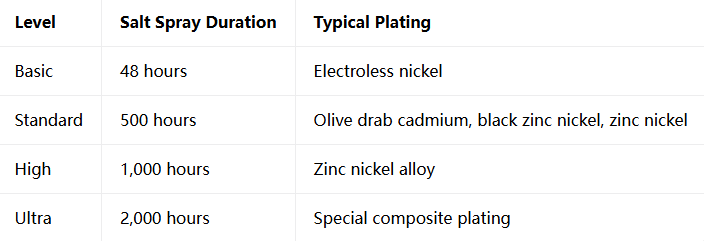
2.Corrosion Resistance Levels
Based on salt spray test duration, the corrosion resistance levels of MIL-C-26482 connectors can be categorized as:
3.Acceptance Criteria
Acceptance criteria after salt spray testing include:
No functional corrosion of the connector
No functional corrosion of the connector
Insulation resistance does not fall below specified limits
No severe defects such as blistering or peeling of shell plating
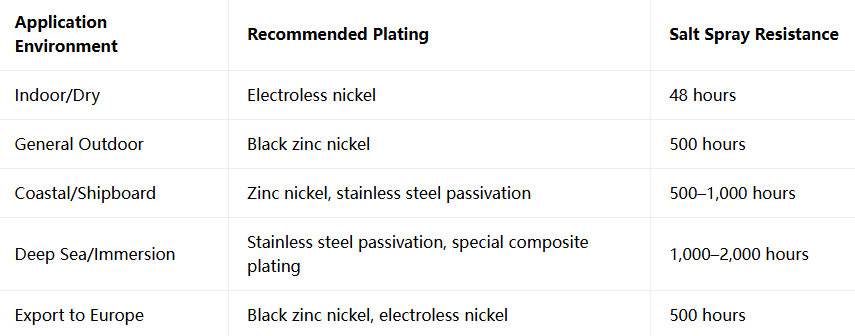
Selection Guide — How to Choose Plating Based on Environment?
Balancing Salt Spray Resistance with Other Factors
When selecting plating, salt spray resistance is not the only consideration,Other factors must also be considered:
Electrical Conductivity: Grounding and EMI shielding require low contact resistance
Operating Temperature: High temperatures may affect the performance of certain platings
Mating Cycles: The wear resistance of the plating affects the connector’s mating life
Cost: Different platings vary significantly in cost
Salt Spray Resistance Starts with Plating
Salt spray is the number one enemy of connectors in marine and coastal environments.MIL-C-26482 connectors can effectively resist salt spray corrosion by selecting appropriate platings.
During selection, choose the most suitable plating based on the actual application environment, compliance requirements, and cost budget.Remember: Salt spray resistance is not about being as high as possible, but as suitable as possible.
Selectable Salt Spray Resistance
Every plating option described above — electroless nickel, black zinc nickel, zinc nickel alloy, stainless steel passivation — our product line covers all of them
Submit your application environment and salt spray requirements | compliance document templates within 24 hours
Recent Posta
Field Maintenance of M83513: How to Quickly Replace Contacts? Our

38999 vs MIL-C-83513: Circular vs Micro-Rectangular Our Products Two Shapes,

Salt Spray Resistance of MIL-C-26482: A Complete Guide to Plating
Get Quote of Connectors