

Field Maintenance of M83513: How to Quickly Replace Contacts?
Field Maintenance of M83513: How to Quickly Replace Contacts? Our
38999 vs MIL-C-83513: Circular vs Micro-Rectangular
Two Shapes, Two Missions
In the world of military connectors, MIL-DTL-38999 and MIL-C-83513 are two distinctly different entities. One is known for its circular shell and robust coupling, the other for its rectangular miniaturization and high-density interconnection. They represent two different design philosophies in military connectors: circular connectors pursue environmental adaptability and mechanical reliability, while micro-rectangular connectors pursue space efficiency and signal density.
This article helps you clarify the core differences between these two connectors from five dimensions — shape, contact density, coupling mechanism, electrical performance, and application scenarios — and provides clear selection guidance.
Shape and Structure — Circular vs Micro-Rectangular
MIL-DTL-38999 uses a circular shell, with plug and receptacle coupled by thread or bayonet. The circular shell has inherent advantages in withstanding internal pressure, resisting external impact, and achieving omnidirectional sealing. Its symmetrical structure allows the connector to distribute force evenly at any angle, suitable for high-vibration and high-pressure environments.
MIL-C-83513 uses a rectangular shell, with plug and receptacle secured by a locking mechanism or screws. The rectangular shell has advantages in space utilization efficiency — within the same panel area, a rectangle can accommodate more contacts. Its flat shape is suitable for PCB mounting and miniaturized equipment.
Key Differences:
Circular: Symmetrical, pressure-resistant, omnidirectional sealing, suitable for cable-end connections
Micro-Rectangular: Flat, high-density, suitable for PCB mounting, suitable for miniaturized equipment
Contact Density and Size — Who Can Carry More Signals in Less Space?
MIL-DTL-38999:
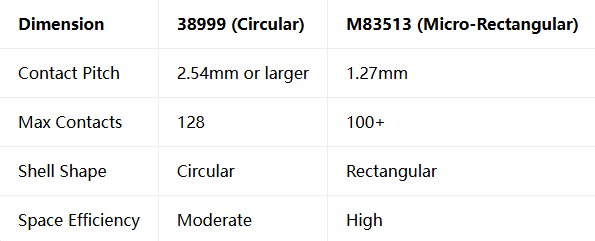
MIL-DTL-38999 shell sizes cover 9 sizes from 09 to 25, with contact counts ranging from a few to 128 contacts. Contact pitch is typically 2.54mm or larger. The contact arrangement in a circular shell is limited by the circumferential space, resulting in relatively lower density.
MIL-C-83513:
MIL-C-83513 uses a 1.27mm grid pitch, achieving high-density contact arrangement in an extremely small rectangular space. Contact counts range from 9 to 100, with some versions expandable further. The contact pitch is only half that of circular connectors, nearly doubling the density.
Coupling Mechanism and Operation — Threaded vs Locking
MIL-DTL-38999:
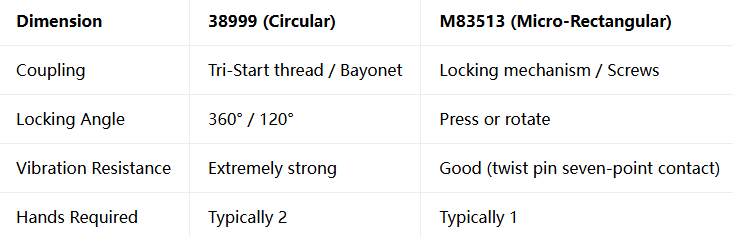
The primary series of MIL-DTL-38999 (Series III) uses Tri-Start thread coupling, locking with one full turn. The thread engagement is deep, providing strong vibration-resistant clamping force with an anti-decoupling ratchet. Operation typically requires two hands — one to hold the receptacle, the other to rotate the plug. Series I and Series II use bayonet coupling, locking with about one-third of a turn.
MIL-C-83513:
MIL-C-83513 uses a locking mechanism or screws for securing. Some versions offer snap-lock, others use screw locking. Mating force is relatively low, and operation is relatively simple. However, due to the extremely small size, more precise alignment is required during mating.
Electrical Performance and Environmental Adaptability
MIL-DTL-38999:
Operating temperature: -65°C to +200°C
Contact current: up to 23A (#12 contacts)
Contact resistance: ≤5mΩ
Insulation resistance: ≥5000MΩ
Sealing: IP67 or higher
EMI shielding: 360° omnidirectional, ≥40dB @ 10GHz
Mating cycles: 500 (composite version up to 1,500)
MIL-C-83513:
Operating temperature: -55°C to +125°C (high-temperature version up to +200°C)
Contact current: 3A
Contact resistance: ≤8mΩ
Insulation resistance: ≥5000MΩ
Insulation resistance: ≥5000MΩ
EMI shielding: Limited (metal shell provides basic shielding)
Mating cycles: 500
38999 leads comprehensively in electrical performance and environmental adaptability — higher current capacity, wider temperature range, stronger sealing and EMI shielding. M83513 holds an absolute advantage in miniaturization and high density.
Application Scenarios — Each in Its Place
Typical Applications of MIL-DTL-38999:
Fighter avionics (high vibration, wide temperature, EMI shielding)
Missile guidance sections (high shock, high vibration)
Shipboard equipment (salt spray, continuous immersion)
Satellite payloads (vacuum, radiation, wide temperature)
Ground C4ISR systems (harsh field environments)
Typical Applications of MIL-C-83513:
Missile guidance sections (miniaturization, high density)
Satellite payloads (low outgassing, lightweight)
UAV avionics (compact space, lightweight)
Medical endoscopes (miniaturization, biocompatibility)
Airborne radar (high-density signal interconnection)
Portable electronic devices (space-constrained, weight-sensitive)
Selection Decision Guide
Choose MIL-DTL-38999 When:
High current capacity required (>3A)
Extremely wide operating temperature range required (-65°C to +200°C)
360° EMI shielding required
Strong vibration resistance and anti-loosening required (threaded coupling)
IP67 or higher sealing rating required
Application scenario is cable-end connection or panel mounting
Choose MIL-C-83513 When:
Space is extremely constrained, requiring a miniaturized connector
High-density contacts required (1.27mm pitch)
Lightweight connector required
Application scenario is PCB mounting
Low outgassing characteristics required (space applications)
Primarily signal transmission, with low current requirements
No “Better,” Only “More Suitable”
MIL-DTL-38999 and MIL-C-83513 are not a case of one replacing the other. Each is the optimal solution in its own domain. Circular connectors are irreplaceable in environmental adaptability and mechanical reliability, while micro-rectangular connectors stand alone in space efficiency and signal density.
The core principle of selection is: match actual requirements, not pursue “stronger” or “smaller.” Ask yourself three questions: How much current is needed? How much space is available? How harsh is the environment? The answers will guide you to the right choice.
Configured to Your Needs
The two standards compared above — MIL-DTL-38999 (circular) and MIL-C-83513 (micro-rectangular) — our product line covers both
Submit your application environment and salt spray requirements | compliance document templates within 24 hours
Recent Posta
Field Maintenance of M83513: How to Quickly Replace Contacts? Our

38999 vs MIL-C-83513: Circular vs Micro-Rectangular Our Products Two Shapes,

Salt Spray Resistance of MIL-C-26482: A Complete Guide to Plating
Get Quote of Connectors