

Field Maintenance of M83513: How to Quickly Replace Contacts?
Field Maintenance of M83513: How to Quickly Replace Contacts? Our
High Density, Small Size, Quick Disconnect — The Three Core Advantages of Push-Pull Connectors

One Connection Method, Solving Three Battlefield Pain Points
Modern military equipment is undergoing a profound transformation: soldier systems are getting lighter, UAV payloads are becoming more compact, and airborne avionics modules are growing denser. In this “miniaturization revolution,” connectors — as the “blood vessels” of signals and power — face unprecedented challenges: how to carry more signals in less space? How to achieve faster operation in harsher environments?
Push-pull connectors answer with three keywords: High Density, Small Size, Quick Disconnect.
These are not three isolated performance labels, but an interconnected design philosophy — high density enables more functionality in less space, small size makes equipment lighter and more flexible, quick disconnect makes battlefield operations faster and more reliable. Together, they form the irreplaceable value of push-pull connectors in the military domain.
High Density — Carrying Thousands of Signals in a Tiny Space
High density refers to the ability to arrange more contacts per unit area or volume. The high-density advantage of push-pull connectors comes from two design directions: contact miniaturization and layout optimization.
Take Amphenol’s 2M804 series as an example — it can accommodate up to 85 signal contacts in a single miniature circular connector. Within the same or smaller package size, push-pull connectors offer contact density far exceeding traditional threaded or bayonet connectors.
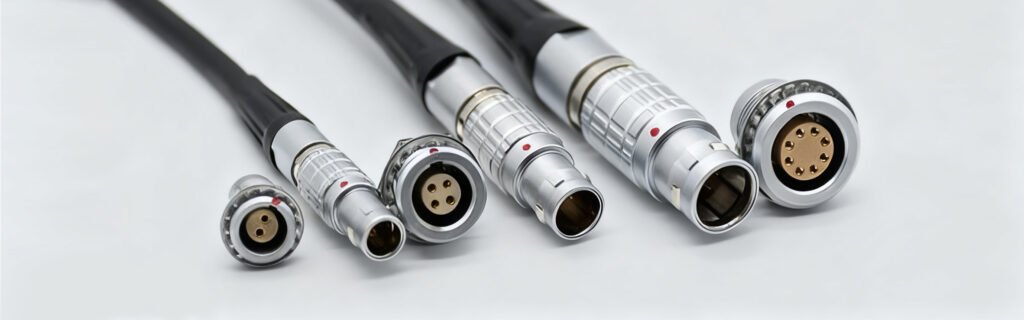
Reduced Contact Pitch:Push-pull connectors use smaller contact sizes (such as #23, #22D, etc.), significantly reducing the center-to-center spacing between contacts. In miniaturized connectors, contact pitch can reach 1.27mm or even smaller. Compared to the 2.76mm pitch of traditional D-Sub connectors, push-pull connectors nearly double the density.
Mixed Contact Configurations:High-density push-pull connectors pursue not just “more contacts” but “full functionality.” The same connector can accommodate signal contacts, power contacts, coaxial contacts, and fiber optic contacts in a mixed arrangement, enabling one-stop transmission of signals, power, and high-speed data. The Fischer MiniMax™ Series offers 4 power contacts and 20 signal contacts in its 24-pin configuration.
Fewer Connectors: One high-density connector can replace multiple low-density connectors, reducing the number of interfaces on equipment panels and lowering failure points.
Simplified Cable Management: Fewer connectors mean fewer cables and cleaner routing — critical for the maintenance of airborne and vehicle-mounted equipment.
Freeing Up Precious Space: In scenarios with extreme space constraints — missile guidance sections, UAV avionics modules — every cubic centimeter freed by high-density connectors could mean additional functional modules or greater fuel capacity.
Small Size — The “Invisible Driver” of SWaP Optimization
“Small size” is not a vague concept — it can be measured with real data.
Amphenol’s 2M micro-miniature connectors are 71% lighter, 52% smaller, and offer 60% higher contact density than comparable products. LEMO’s OPTIMA D Series overmolded plug is 25% shorter than standard LEMO connectors. TT Electronics’ MIL-PP series claims to be the lightest connector of its type — 35% lighter than the nearest equivalent.
More intuitive is the size comparison. A comparison between Amphenol’s 2M804 series and the D38999 series with the same number of contacts shows that:
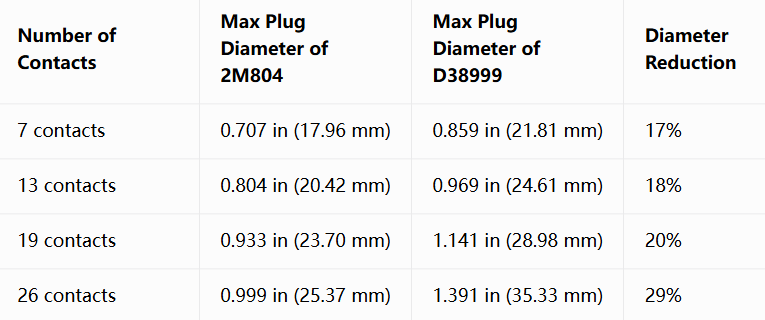
With the same number of contacts, push-pull connectors offer diameter reductions of 17% to 29%. This means significantly less panel space is occupied, freeing up room for other functional modules.
Soldier-Worn Systems: Soldiers carry an increasing number of electronic devices — radios, GPS, night vision, life monitoring systems. Every gram affects mobility and endurance. The small size and lightweight design of push-pull connectors allow these devices to be more compactly integrated into tactical vests without adding burden.
UAVs and Missiles: In aircraft, weight directly impacts range and payload. A few grams saved per connector, multiplied by hundreds of connectors, can translate into kilograms of weight savings — which can be converted into more fuel or a larger warhead.
Airborne Avionics Modules: Modern fighter avionics systems must integrate radar, communications, navigation, electronic warfare and more within limited space. The small size of push-pull connectors enables thinner, denser modules, accommodating more functional boards in the same chassis space.
The small size of push-pull connectors does not come at the cost of performance. They still meet military-grade stringent requirements:
Operating Temperature: -65°C to +200°C
Sealing Rating: IP68 (both mated and unmated)
Shock Resistance: 150G
Salt Spray Resistance: 500 hours+
EMI Shielding: 360° omnidirectional
How Do the Three Advantages Work Together?
High density, small size, and quick disconnect are not three isolated features — they are a mutually reinforcing whole.
High density enables small size: Only by arranging more contacts per unit area can the same number of signals be carried in a smaller package. Conversely, without sufficient density, reducing size means sacrificing functionality.
Small size makes quick disconnect more valuable: In tight spaces, rotational operation is often difficult or impossible. The small size of push-pull connectors, combined with quick disconnect, makes connections easy even in dense chassis panels or narrow compartments.
Quick disconnect makes high density more reliable: High density means more contacts and tighter tolerances. The blind-mate capability and self-locking mechanism of push-pull connectors ensure reliable connections even under high-density conditions.
Together, they form the “iron triangle” of push-pull connectors in the military domain — none can be missing, each supports the others.
Typical Application Scenarios at a Glance
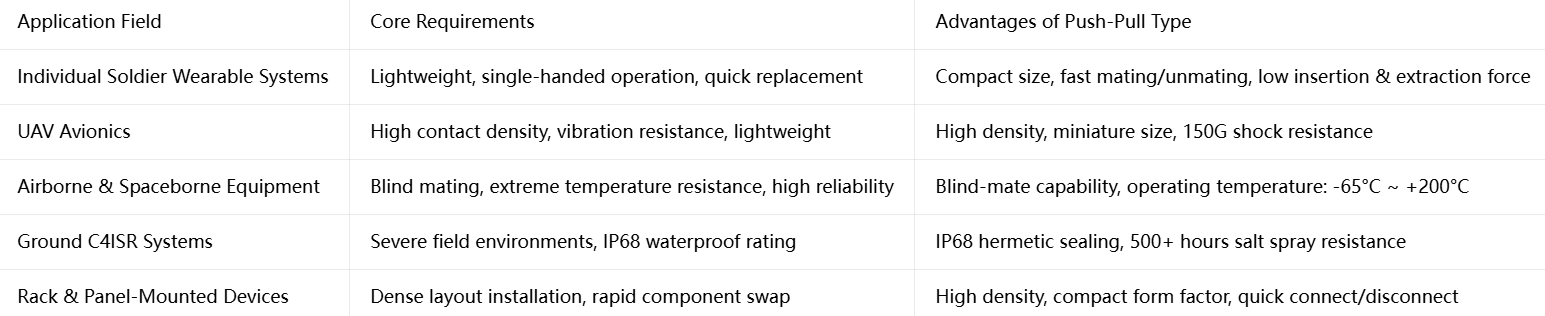
Three Advantages, One Answer
High density, small size, quick disconnect — these three words define the core value of push-pull connectors in the military domain. They are not marketing slogans, but engineering solutions that genuinely solve battlefield pain points.
In soldier systems, they make equipment lighter and operation faster. On UAVs, they make payloads more compact and range longer. In airborne avionics, they make modules denser and maintenance more efficient. From -65°C extreme cold to +200°C high temperature, from desert dust to deep-sea immersion, push-pull connectors deliver a battlefield-proven answer with these three advantages.
Higher density to carry more, smaller size to occupy less, quicker disconnect to respond faster — this is the ultimate demand of modern military equipment for connectors.

Recent Posta
Field Maintenance of M83513: How to Quickly Replace Contacts? Our

38999 vs MIL-C-83513: Circular vs Micro-Rectangular Our Products Two Shapes,

Salt Spray Resistance of MIL-C-26482: A Complete Guide to Plating
Get Quote of Connectors