

Field Maintenance of M83513: How to Quickly Replace Contacts?
Field Maintenance of M83513: How to Quickly Replace Contacts? Our
How Many 38999 Connectors Are in a Fighter Jet? A Number You Might Not Imagine
A Number You’ve Never Noticed
A modern fighter jet is densely packed with countless cables and connectors inside, from the nose radome all the way to the aft engine bay. Silent and unilluminating, they form the aircraft’s nervous system: every cable transmits signals, and every connector guarantees uninterrupted signal transmission.
So, exactly how many connectors are in a fighter jet? And how many of them are MIL-DTL-38999?
The answer is: more than 1,000. Just this single connector type — MIL-DTL-38999 — is used in more than 1,000 instances on the Lockheed Martin F-35 Lightning II. And this is only part of the F-35’s total of 3,200 connectors.
The F-35’s “Connector Ledger” — What Do 3,200 Connectors Mean?
The F-35 is a complex machine composed of over 300,000 parts produced by more than 1,800 suppliers from over 30 countries. Assembling a single F-35 requires:
17,000 bolts, nuts, and rivets
42,000 cables
850 fiber optic lines
3,200 connector
Of these 3,200 connectors, more than 1,000 are of the MIL-DTL-38999 series. This means:
1 in every 3 connectors is a 38999
38999 is the single most widely used connector model on the F-35
If lined up end to end, these connectors would span over 30 meters
The “Hidden Number” of Fiber Optic Connectors
Beyond traditional electrical connectors, the F-35 also carries more than 300 fiber optic connectors. A significant portion of these are also MIL-DTL-38999 series — Glenair’s SuperNine® fiber optic interconnect system is based on MIL-DTL-38999 Series III and has been successfully deployed in hundreds of aerospace applications, from F-16 upgrade systems to the F-35.
Why 38999? — One Standard Ruling for Half a Century
MIL-DTL-38999 didn’t appear out of nowhere. Its predecessor, MIL-C-38999, was born in the 1970s and has been in service for over 50 years. Over this half-century, it has evolved from a connector standard into the de facto standard of military aviation.
The Four Series of 38999:
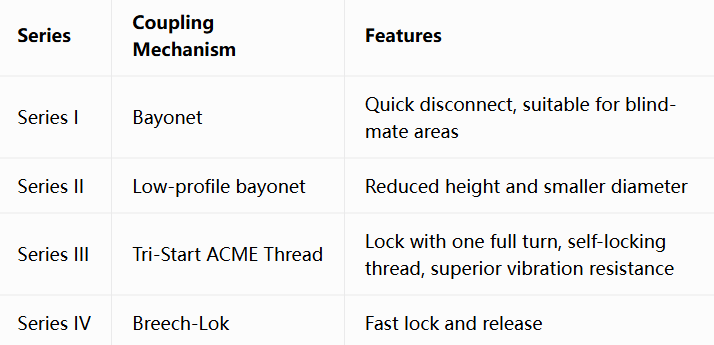
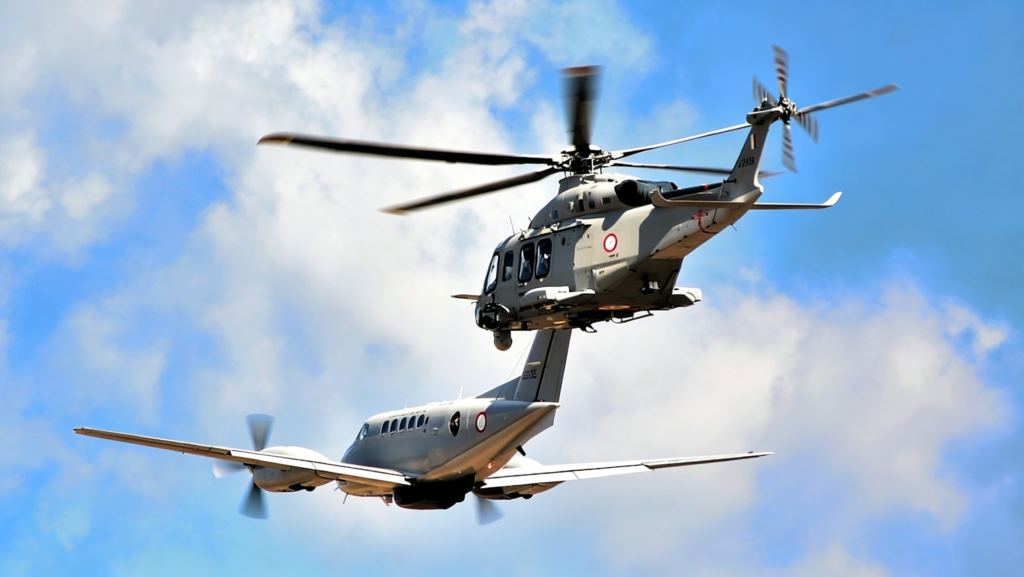
The F-35 extensively uses Series III, the highest-performance, most vibration-resistant version of the 38999 family. It features Tri-Start ACME thread coupling — one turn locks it tight — with a self-locking mechanism that prevents loosening in high-vibration environments. Series III is engineered for the harshest conditions and is often specified for high-shock, high-vibration vehicles — fighters, rotorcraft, UAVs, and missiles.
How Did 38999 Conquer the F-35? — Six Core Capabilities
1. Extreme Environment Survivability
The F-35’s operational environment ranges from -65°C to +200°C. The 38999’s operating temperature range is exactly -65°C to +200°C. Whether in Siberian cold or engine bay heat, the 38999 performs reliably.
In salt spray resistance, the electroless nickel version of 38999 can withstand 2,000 hours of salt spray corrosion. This means that in the high-salt environment of an aircraft carrier deck, the 38999 can serve for decades without corroding.
2. 1,500 Mating Cycles and 300G Shock Resistance
Over a fighter jet’s lifecycle, avionics modules are repeatedly removed and reinstalled for maintenance and upgrades. The 38999’s mating cycle life reaches 1,500 cycles — meaning the connector won’t fail due to mating wear over its entire service life.
Even more impressive is its shock resistance: Series III withstands 300G shock and maintains signal continuity —interruption of no more than one microsecond — under sine and random vibration. For flight control and weapon systems, that one microsecond difference can be the distance between life and death.
3. 360° EMI/RFI Shielding
The modern battlefield electromagnetic environment is extremely complex — from friendly radar and communication equipment to enemy electronic jamming. The 38999 integrates 360° omnidirectional EMI/RFI shielding, achieved through metal-to-metal coupling and grounding fingers, providing up to 65dB of shielding effectiveness at 10GHz. On a platform like the F-35, which integrates advanced electronic warfare and ISR capabilities, this is absolutely critical.
4. Scoop-proof Protection
In battlefield emergency maintenance, technicians may not be able to carefully align connectors. The 38999’s 100% scoop-proof design protects pins by recessing them within elongated shells — even if the plug is inserted at an angle, the pins won’t be damaged. This is a huge advantage for front-line maintenance.
5. IP67 Environmental Sealing
The 38999 offers IP67-rated sealing, providing complete protection against dust ingress and resistance to temporary immersion. In the humid environment of an aircraft carrier deck or the sandstorms of the desert, this sealing rating ensures long-term connector reliability.
6. Lightweighting — The Secret to Saving 50 Pounds
The F-35 program is extremely weight-sensitive — every extra pound can impact performance. ITT Interconnect Solutions’ Director of Engineering once noted: “If the 38999 connectors used carbon fiber composite housings instead of metal, just the connectors alone could save up to 50 pounds.”
Composite shells can reduce weight by 17% to 70% compared to aluminum shells. For a fighter jet, 50 pounds means more fuel, longer range, or greater payload. Notably, the composite MIL-DTL-38999 is a direct replacement for the metallic version and meets most of its performance requirements.
Where 38999 “Hides” on the F-35
The 1,000+ 38999 connectors on the F-35 are distributed across every critical system of the aircraft:
Avionics: Flight control computers, displays, navigation equipment
Radar: AN/APG-81 AESA radar signal and power connections
Communications: Radios, datalinks, satellite communications
Electronic Warfare: Jammers, warning receivers
EO/IR: Electro-Optical Targeting System (EOTS), Distributed Aperture System (DAS)
Engine Control: F135 engine sensors and actuator connections
Weapons: Internal weapons bay and external stores signal and power distribution
Fiber Optic: Over 300 fiber optic connectors for high-speed data transmission
In every system, the 38999 plays the same role: ensuring signals are never interrupted under extreme conditions.
From F-35 to the Entire Industry — 38999’s Dominance
The F-35 is not the only platform using 38999. From F-16 upgrade systems to the F-35, from military aircraft to commercial aviation, from UAVs to ground C4ISR systems, the 38999 is everywhere.
Amphenol Aerospace calls MIL-DTL-38999 “the modern standard for high-performance circular connectors”. TE Connectivity notes that it is “a popular and widely used subminiature circular connector for military and aerospace applications”.
Global Deployment Scale:
It is estimated that there are millions of 38999 series connectors currently in service worldwide. From F-16, F-15, F/A-18 to the Eurofighter Typhoon, from C-130 transport aircraft to the Boeing 787, the 38999 is everywhere. It is not only a military standard but has also been adopted by commercial aviation giants like Boeing as part of their BACC specifications.
The Future of 38999 — From Copper to Light, From Metal to Composite
The 38999 has not stood still since its 1970s design. It is continuously evolving.
Fiber Optic Integration:
With the explosive growth in data transmission rates required by fighter jets, the 38999 has evolved from a purely electrical connector to an opto-electronic hybrid connector. Glenair’s SuperNine® series offers a multi-channel fiber optic interconnect system based on MIL-DTL-38999 Series III, supporting 2 to 37 fiber optic termini with insertion loss as low as 0.3dB.
Composite Material Adoption:
Carbon fiber composite shells are becoming the new standard for 38999. Amphenol’s Composite Tri-Start Connector has been approved for F-35/JSF applications, significantly reducing weight while maintaining the same high performance.
RoHS Compliance:
For customers exporting to European markets, the 38999 is now available with RoHS-compliant, cadmium-free options, including black zinc nickel and electroless nickel platings, ensuring products can enter the EU market smoothly.
The Unseen Connections
More than 1,000 38999 connectors, 3,200 total connectors, 42,000 cables, 850 fiber optic lines — behind these numbers lies the complexity of the F-35 as the world’s most advanced fighter jet. Every 38999 connector works silently, enduring extreme temperatures, severe vibration, and ubiquitous electromagnetic interference.
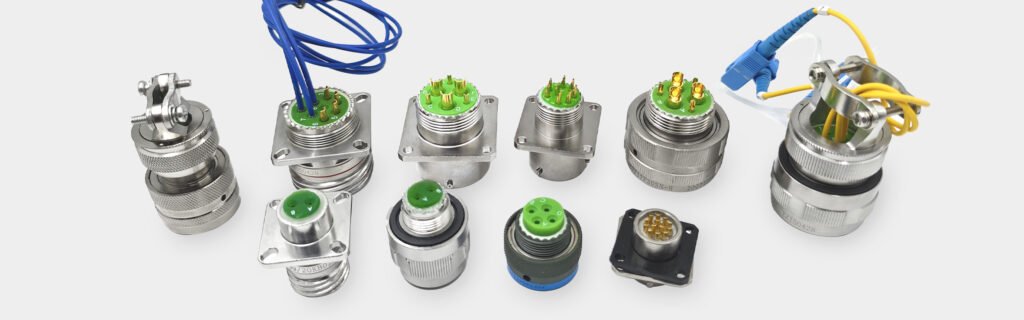
From the 1970s to today, from MIL-C-38999 to MIL-DTL-38999, from metal shells to composite materials, from copper to fiber optics — the 38999 has proven itself through half a century of evolution. Millions of connectors in service, hundreds of aerospace platforms, and countless successful missions in extreme environments — this is the 38999’s track record.
They make no sound, but they are never absent.
Next time you see an F-35 streak across the sky, remember: inside that invisible interior, more than 1,000 38999 connectors are ensuring that this fighter — and the pilot flying it — complete their mission safely.
38999 Selection — We Help You Take the Final Step
The 1,000+ 38999 connectors on the F-35 must each ensure uninterrupted signals under extreme conditions. Our product line is designed to the exact same standards.
Send your project requirements
Receive selection advice + compliance document templates within 24 hours
Recent Posta
Field Maintenance of M83513: How to Quickly Replace Contacts? Our

38999 vs MIL-C-83513: Circular vs Micro-Rectangular Our Products Two Shapes,
Salt Spray Resistance of MIL-C-26482: A Complete Guide to Plating
Get Quote of Connectors