

Field Maintenance of M83513: How to Quickly Replace Contacts?
Field Maintenance of M83513: How to Quickly Replace Contacts? Our
MIL-C-26482 vs MIL-DTL-38999: Bayonet vs Threaded, Which Is Your Best Choice?
Two Classics, One Choice
In the world of military circular connectors, MIL-C-26482 and MIL-DTL-38999 are two names you cannot avoid. Both are U.S. military standard connectors, both offer environmental resistance and high reliability, and both have served in aviation, aerospace, and defense for decades. But when engineers select connectors, the most common question is: Between these two standards, which one should I choose?
The answer often lies in their most fundamental difference: coupling mechanism. MIL-C-26482 features bayonet coupling, locking in approximately one-third of a turn; MIL-DTL-38999’s primary series (Series III) features tri-start thread coupling, locking in one full turn.
These two coupling methods represent two different engineering philosophies: speed vs reliability. This article helps you clarify the differences between the two from four dimensions — standard system, coupling mechanism, performance parameters, and application scenarios — and provides clear selection guidance.
MIL-C-26482 — The “Quick-Draw” of Bayonet Coupling
1.1 Standard Traceability
MIL-C-26482 was originally issued in the 1950s as a U.S. Department of Defense military standard for miniature, circular, quick-disconnect, environment-resisting electrical connectors. It was born out of the demand from military avionics for higher contact density, smaller size, and faster operation speed.
The standard underwent multiple revisions. MIL-C-26482G was issued in 1975. In 2007, the standard was officially superseded by MIL-DTL-26482H, shifting from a “procurement specification” to a “performance specification.” But regardless of the version, its core design features remained unchanged: three-point bayonet coupling, a five-key/keyway polarization system, and environmental sealing.
MIL-C-26482 defines two series of connectors: Series 1 and Series 2. Series 1 operates from -55°C to +125°C with solder or front-release crimp contacts; Series 2 operates from -55°C to +200°C with rear-release crimp contacts and improved sealing.
1.2 Mechanical Principle of Bayonet Coupling
The core structure of bayonet coupling is: the receptacle features three stainless steel bayonet pins evenly distributed around the circumference; the plug’s coupling ring has three ramps machined into its inner surface. After pushing the plug into the receptacle, the operator rotates the coupling ring clockwise approximately one-third of a turn (about 120°), and the pins slide along the ramps until they seat into the locking detents at the end.
The coupling ring contains a wave washer. Once the bayonet pins seat into the locking detents, the wave washer continuously applies axial tension, keeping the pins pressed firmly against the bottom of the detents, ensuring no self-loosening under severe vibration.
1.3 Advantages and Limitations of Bayonet Coupling

MIL-DTL-38999 — The “King of Reliability” with Tri-Start Thread
2.1 Standard Traceability
MIL-DTL-38999 (formerly MIL-C-38999) was born in the 1970s to meet the trend toward “more signal, less power” in military avionics at the time. After decades of evolution, it has become one of the most popular and widely used connector standards in global military aviation, aerospace, and demanding industrial environments.
The standard defines four series: Series I (bayonet), Series II (low-profile bayonet), Series III (tri-start thread), and Series IV (breech-lok). Among them, Series III is the most widely used series and the “main contender” when comparing with MIL-C-26482.
2.2 Mechanical Principle of Tri-Start Thread
Tri-Start ACME Thread is a special multi-start thread design. Compared to traditional single-start threads, it has three thread starting points and a larger lead. The operator only needs to rotate one full turn (360°) to lock — although the number of turns is more than bayonet, the thread engagement depth is deeper and the contact area is larger.
The coupling nut of Series III features a built-in anti-decoupling ratchet mechanism. When the connector is fully locked, the ratchet produces a clear “click,” and significantly greater torque is required to unscrew it. This design ensures the connector does not self-loosen under extreme vibration.
2.3 Advantages and Limitations of Tri-Start Thread

Comprehensive Core Parameter Comparison
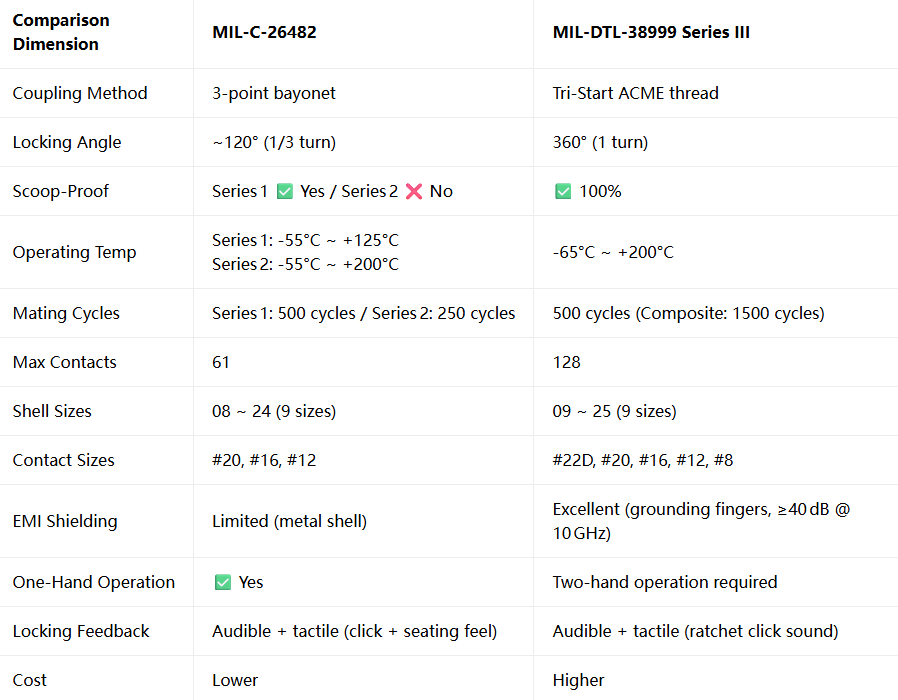
Scenario-Based Selection — When to Choose Bayonet and When to Choose Threaded?
Choose MIL-C-26482 (Bayonet) When:
Choose MIL-DTL-38999 (Tri-Start Thread) When:
No “Best,” Only “Most Suitable”
MIL-C-26482 and MIL-DTL-38999 are not a case of one replacing the other — both are excellent designs in their respective positions. The bayonet-coupled 26482 is the balancer of speed and convenience, suitable for scenarios requiring fast operation and one-hand maintenance; the tri-start threaded 38999 is the high-performance king of vibration resistance and reliability, suitable for the most demanding aviation and missile applications.
The core principle of selection is: match your actual working environment, rather than pursuing the “newest” or “most expensive.” Ask yourself three questions: What signals are you transmitting? In what environment is it working? How fast does the operation need to be? The answers will guide you to the right choice.
Bayonet and Threaded, Configured to Your Needs
The two standards compared above — MIL-C-26482 (bayonet) and MIL-DTL-38999 (tri-start thread) — our product line covers both
Submit your signal type and data rate requirements | Receive selection advice
Recent Posta
Field Maintenance of M83513: How to Quickly Replace Contacts? Our

38999 vs MIL-C-83513: Circular vs Micro-Rectangular Our Products Two Shapes,

Salt Spray Resistance of MIL-C-26482: A Complete Guide to Plating
Get Quote of Connectors