

Field Maintenance of M83513: How to Quickly Replace Contacts?
Field Maintenance of M83513: How to Quickly Replace Contacts? Our
Push-Pull Connector Selection Pitfalls: 5 Common Misconceptions and Corrections
The “Invisible Traps” in Selection
Push-pull connectors, with their push-to-lock and pull-the-sleeve-to-release operation, have become the preferred choice for quick disconnect in military and high-end industrial equipment. However, during actual selection, engineers and procurement professionals often fall into misconceptions that seem reasonable but are actually risky. These pitfalls can lead to the wrong connector being chosen, resulting in signal interruption, sealing failure, or even field failures.
This article breaks down the five most common misconceptions in push-pull connector selection and provides clear corrective guidance.
Misconception #1 — All Push-Pull Connectors Can Blind Mate
Misconception: As long as a connector uses push-pull coupling, it can definitely achieve blind mating without any alignment considerations.
Reality: Blind-mate capability depends on the connector’s guide features and polarization keying design — not all push-pull connectors are inherently capable. Some push-pull connectors can be mated quickly, but are still difficult to align when visibility is limited. True blind-mate capability requires: guide chamfers or guide pins that allow a certain range of angular misalignment; a multi-key polarization system to prevent misinsertion; and clear mating feedback to confirm the connection is fully engaged.
Correct approach: During selection, explicitly ask whether the connector has blind-mate capability and request mating tolerance data. For blind-mate scenarios such as rack backplanes and avionics modules, choose push-pull connectors with guide features and well-defined polarization keying.
Misconception #2 — The Lower the Mating Force, the Better
Misconception: The lower the mating force, the easier the operation, and therefore the better the choice.
Reality: Lower mating force is not always better. Excessive low mating force can cause the connector to accidentally disconnect in high-vibration environments, resulting in signal interruption. The mating force of a push-pull connector must match its locking mechanism and application scenario. For example, push-pull connectors with ball detent locking typically require a certain insertion and separation force to ensure the locking elements engage reliably; connectors with breakaway functionality require a precisely set release force so that they disconnect only under a predetermined pull.
Correct approach: Determine the mating force range based on the vibration level and operation frequency of the application. For high-vibration environments, choose standard or slightly higher mating force; for frequent operation, choose low-force versions. Request measured mating force data from the supplier rather than relying only on nominal values.
Misconception #3 — IP67 Is Enough for All Environments
Misconception: IP67 already provides waterproof and dustproof protection, sufficient for all harsh environments, and no higher sealing rating is needed.
Reality: IP67 only guarantees no water ingress during 30 minutes of immersion at 1 meter depth. For shipboard deck equipment, deep-sea equipment, or applications requiring high-pressure washdown, IP67 is far from sufficient. In addition, many connectors’ IP67 sealing is only effective in the mated condition — once unmated, the seal is lost. For applications requiring waterproofing in the unmated condition, choose push-pull connectors that support unmated sealing.
Correct approach: Clarify the actual water pressure, immersion duration, and washdown conditions the equipment will face. For shipboard or deep-sea applications, prioritize IP68 or IP69K, and confirm whether the supplier provides sealing data for both mated and unmated conditions.
Misconception #4 — Push-Pull Connectors Have Lower Vibration Resistance Than Threaded Connectors
Misconception: Threaded connectors provide the strongest vibration-resistant clamping force through multiple thread engagements, and push-pull connectors, lacking threads, must have inferior vibration resistance.
Reality: The vibration resistance of a push-pull connector does not depend on threads, but on the design of its locking mechanism. High-quality push-pull connectors use a spring-loaded locking sleeve; the locking elements remain under continuous spring pressure after mating, ensuring they do not loosen under vibration. Some push-pull connectors even outperform threaded connectors in vibration resistance, because threaded connectors may still experience fretting wear due to thread clearance under extreme vibration, while the spring preload of push-pull connectors continuously compensates for such clearance.
Correct approach: Do not judge vibration resistance by whether the connector has threads. Instead, review the connector’s vibration test data. Check whether it passes MIL-STD-810 or equivalent vibration testing, and examine the signal interruption performance during the test.
Misconception #5 — Push-Pull Connectors Have Short Lifespan and Are Not Suitable for Frequent Mating
Misconception: Push-pull connectors have a simple locking structure, and their mating life may be only a few hundred cycles, unable to withstand frequent mating scenarios.
Reality: The mating life of a push-pull connector is closely related to its locking mechanism, contact design, and material selection. High-quality push-pull connectors can achieve 2,000 to 5,000 mating cycles, far exceeding the 500 cycles of standard threaded or bayonet connectors. The spring and locking elements inside the locking sleeve are precision-designed and rigorously tested to maintain stable locking force after thousands of operations.
Correct approach: Choose the connector based on the expected number of mating cycles over the equipment’s full lifecycle. For frequently mated battlefield Line Replaceable Units, choose push-pull connectors with a life of 5,000 cycles or more. Also note that mating life is measured under standard test conditions; actual harsh environments may shorten effective life, so a safety margin should be reserved during selection.
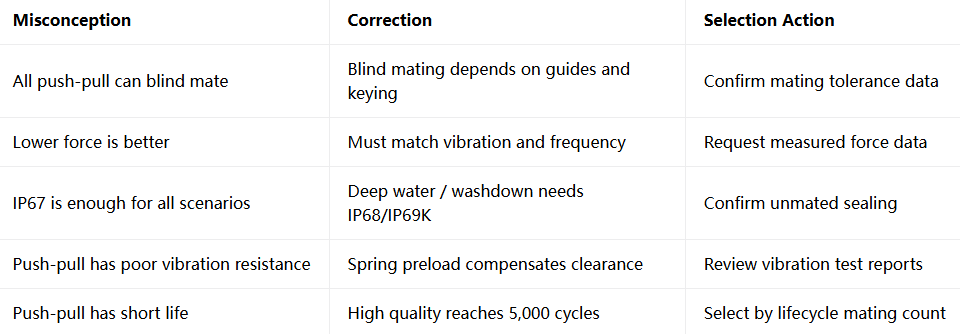
Selection Self-Check List
Avoid Pitfalls and Choose the Right Connector
Selecting a push-pull connector is not simply a matter of checking a few parameters; it requires understanding the engineering logic behind each parameter. Blind-mate capability, mating force, sealing rating, vibration resistance, and mating life — each of these five dimensions can lead to a selection error due to a common misconception.
Remember: Blind mating is not inherent, lower mating force is not always better, IP67 is not universal, vibration resistance is not about threads, and lifespan is not about structural simplicity. Avoid these five pitfalls, and you can lock onto the push-pull connector configuration that best fits your project requirements.
Avoid Selection Pitfalls, Match Your Needs Precisely
Submit your selection requirements | Receive pitfall-avoidance advice + compliance document templates within 24 hours
Recent Posta
Field Maintenance of M83513: How to Quickly Replace Contacts? Our

38999 vs MIL-C-83513: Circular vs Micro-Rectangular Our Products Two Shapes,

Salt Spray Resistance of MIL-C-26482: A Complete Guide to Plating
Get Quote of Connectors