

Field Maintenance of M83513: How to Quickly Replace Contacts?
Field Maintenance of M83513: How to Quickly Replace Contacts? Our
Push-Pull vs Threaded vs Bayonet: Selection Guide for the Three Military Coupling Mechanisms
This article helps you fully understand the differences among these three coupling mechanisms from five dimensions: working principle, operational experience, vibration resistance, mating cycles, and application scenarios — and provides clear selection guidance.
One Choice, Three Answers
In the world of military connectors, the coupling mechanism determines how the operator locks the plug and receptacle together. This seemingly simple choice profoundly affects the equipment’s operational speed, reliability, maintenance cost, and battlefield survivability.
Currently, military circular connectors primarily use three coupling methods: Threaded, Bayonet, and Push-Pull . Each has its strengths and weaknesses. Choose correctly, and battlefield efficiency multiplies; choose incorrectly, and you may find yourself unable to complete a connection at the critical moment.
Threaded Coupling — The Oldest, the Most Reliable
1.1 Working Principle
Threaded coupling is one of the oldest mechanical connection methods in human history. Its principle is simple and reliable: the external threads on the plug housing engage with the internal threads on the receptacle housing, locking through multiple rotations.
In the military connector domain, the typical representative of threaded coupling is the Tri-Start ACME Thread used in MIL-DTL-38999 Series III, which locks with one full turn (360°) . Compared to traditional single-start threads, Tri-Start threads have a larger lead, faster locking speed, and deeper thread engagement for better vibration resistance.
1.2 Core Advantages
Highest Clamping Force: Threaded coupling delivers the strongest mechanical locking force among the three connection types, making it suitable for long-term high-vibration environments. In continuously high-vibration applications such as areas surrounding fighter jet engines and missile sections, threaded connectors represent the most reliable option.
Mature standard system: Threaded coupling has the most comprehensive military standard system support, including widely used specifications such as MIL-DTL-38999, with mature supply chains and convenient selection.
No additional locking required: The friction and self-locking characteristics of the threads themselves are sufficient to maintain locking in most vibration environments, without the need for additional measures such as lockwire.
1.3 Limitations
Slow operation speed: Threaded coupling requires multiple rotations to lock, typically taking 5-10 seconds. In time-sensitive battlefield environments, this speed can become a bottleneck.
Two hands required: Threaded coupling typically requires one hand to hold the receptacle and the other to rotate the plug, meaning soldiers must put down their weapons or abandon situational awareness on the battlefield.
Difficult blind mating: Threaded coupling requires visual alignment of the threads before rotation can begin, making operation difficult in darkness or obstructed visibility.
1.4 Typical Applications
Fighter engine compartments (continuous high temperature, high vibration)
Missile sections and launchers
Long-term fixed-installation avionics equipment
Scenarios with the highest reliability requirements and low speed requirements
Bayonet Coupling — The Balancer of Speed and Reliability
2.1 Working Principle
Bayonet coupling achieves locking through the interaction of bayonet pins on the plug and bayonet slots on the receptacle. After pushing the plug into the receptacle, the operator rotates approximately one-third of a turn (120°) , and the pins slide along the ramps of the slots into the locking position .
In the military connector domain, the typical representative of bayonet coupling is MIL-C-26482 (now MIL-DTL-26482) . This standard defines two series: Series I operates from -55°C to +125°C with solder or front-release crimp contacts ; Series II operates from -55°C to +200°C with rear-release crimp contacts .
Bayonet coupling is also widely used in MIL-DTL-38999 Series I and Series II . Series I uses standard bayonet coupling with scoop-proof design; Series II uses low-profile bayonet coupling but is not scoop-proof, suitable for space- and weight-constrained applications .
2.2 Core Advantages
Moderate speed, convenient operation: Bayonet coupling is much faster than threaded, requiring only about one-third of a turn . Operation time is typically around 2-3 seconds.
One-hand operable: Bayonet coupling can be completed with one hand — hold the plug and rotate the coupling ring with thumb and forefinger .
Tactile + audible dual feedback: When fully locked, the bayonet pins seating into the locking detents produce a clear “click” , and the operator can feel the engagement. This feedback is critical in darkness or noisy environments.
Five-point polarization: Bayonet connectors typically feature a five-key/keyway polarization system with multiple rotation configurations to prevent misinsertion between connectors of the same shell size on the same panel .
2.3 Limitations
Some series not scoop-proof: Low-profile bayonet connectors such as MIL-DTL-38999 Series II sacrifice scoop-proof protection to reduce size and weight . Extra care is required in blind-mating applications.
Moderate mating cycles: Bayonet connectors typically offer 500 mating cycles. For frequently mated/unmated Line Replaceable Units (LRUs), this may be insufficient for the full lifecycle.
2.4 Typical Applications
Avionics equipment (balance of speed and reliability)
Ground C4ISR systems
Space- and weight-constrained equipment
Scenarios requiring quick disconnect but not extreme vibration
Push-Pull Coupling — The King of Speed and Blind Mating
3.1 Working Principle
Push-pull coupling is a self-locking circular connector system that enables fast mating and unmating without rotation . Its core principle: the spring-loaded locking sleeve on the plug housing is compressed during insertion, and internal locking elements (such as balls or latches) expand outward; once fully inserted, the locking sleeve rebounds under spring force, pressing the locking elements into the locking grooves of the receptacle shell, forming a positive mechanical lock.
In the military domain, the standard for push-pull connectors is MIL-C-81703 (superseded by SAE-AS81703 in 1998) . This standard defines three series of environment-resisting, circular, miniature electrical connectors with removable crimp and/or non-removable solder contacts .
Push-pull connectors have a long history in launch vehicle umbilicals and ground support equipment, becoming the de facto standard for launch pad umbilicals in the Space Shuttle, Atlas, Titan, Delta, and other programs .
3.2 Core Advantages
Fastest mating speed: Push-pull connectors are much faster than threaded and bayonet — push to lock, pull the sleeve to release — with operation time typically under 1 second.
Excellent blind-mate capability: The guide features and polarization key systems of push-pull connectors guide the plug into the correct position even when it cannot be seen . DBAS 9 connectors are designed specifically for blind-mate applications.
One-Hand Operation: Push-pull connectors require only one hand for the entire operation — push to lock, pull to unlock, allowing the other hand to maintain constant control over weapons or equipment.
Triple feedback confirmation: Push-pull connectors provide audible (click), tactile (locking sensation), and visual (mating indicator band) triple feedback . Amphenol’s push-pull connectors provide audible and tactile feedback upon mating, immediately confirming the connection .
Highest mating cycles: Push-pull connectors offer significantly higher mating cycle life than threaded and bayonet, with industry-standard products achieving 2,000 to 5,000 cycles. The ODU AMC series offers over 5,000 mating cycles .
No tools required: All operations of push-pull connectors require no tools .
High sealing rating: Push-pull connectors typically offer IP68 protection, with some products achieving IP68 even in unmated condition .
3.3 Limitations
Lower Vibration Resistance than Threaded: Although the spring-loaded locking design of push-pull connectors delivers good vibration resistance, their clamping force is still slightly lower than that of threaded coupling under extreme continuous vibration conditions.
Higher cost: The precision mechanical structure of push-pull connectors makes their manufacturing cost typically higher than threaded and bayonet.
Relatively younger standard system: Compared to the decades of standard accumulation for threaded and bayonet, the military standard system for push-pull (MIL-C-81703 / SAE-AS81703) is relatively newer, with less comprehensive standard support in some application scenarios.
Comprehensive Comparison of the Three Coupling Mechanisms
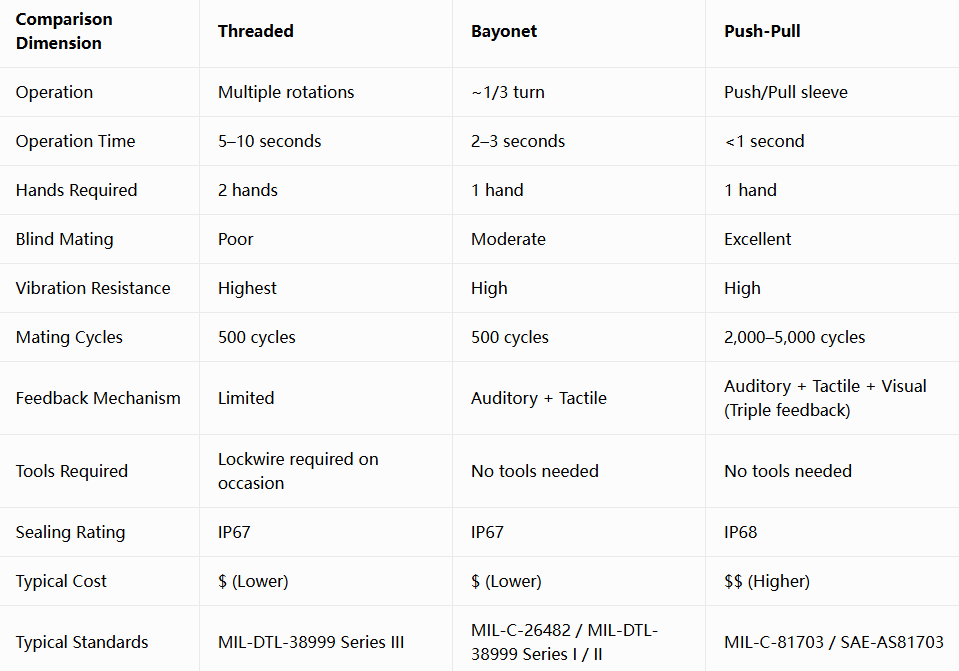
Selection Decision Guide — Four Questions to Lock In the Answer
Q1: Is operational speed critical?
Q2: Is the application in a continuous high-vibration environment?
Q3: Is blind mating or one-hand operation required?
Q4: How high is the mating frequency?
No Single Best, Only the Most Suitable
Threaded, bayonet, and push-pull — each of the three coupling mechanisms has its own irreplaceable value proposition:
Threaded: The king of vibration resistance — suitable for continuous high-vibration, long-term fixed installation scenarios
Bayonet: The balancer of speed and reliability — suitable for scenarios requiring quick disconnect but not extreme vibration
Push-Pull: The king of speed and blind mating — suitable for battlefield scenarios requiring ultra-fast mating, blind mating, and one-hand operation
The choice depends on your application’s priorities in terms of speed, vibration resistance, blind-mate capability, mating cycles, and cost. Remember: Push-Pull is fastest, Threaded is most stable, Bayonet is most balanced.
Every coupling mechanism described above — Threaded, Bayonet, and Push-Pull — our product line covers all of them, and all are available with RoHS-compliant plating options (Black Zinc Nickel / Electroless Nickel), ensuring your equipment enters the European market smoothly.
Submit your project requirements (coupling type / environmental conditions / mating frequency) | Receive selection advice + compliance document templates within 24 hours
Recent Posta
Field Maintenance of M83513: How to Quickly Replace Contacts? Our

38999 vs MIL-C-83513: Circular vs Micro-Rectangular Our Products Two Shapes,

Salt Spray Resistance of MIL-C-26482: A Complete Guide to Plating
Get Quote of Connectors