


Field Maintenance of M83513: How to Quickly Replace Contacts?
Field Maintenance of M83513: How to Quickly Replace Contacts? Our
Three Bayonet Pins, One Twist to Lock: The Mechanical Principle and Battlefield Advantages of 26482 Bayonet Coupling
In the world of military connectors, threaded coupling is the “old-school reliable” — four full turns to lock, dependable but slow. Bayonet coupling is the “quick-draw” — locking in just one-third of a turn. MIL-C-26482 employs exactly this three-point bayonet coupling system.

The “Quick-Draw” of the Connector World
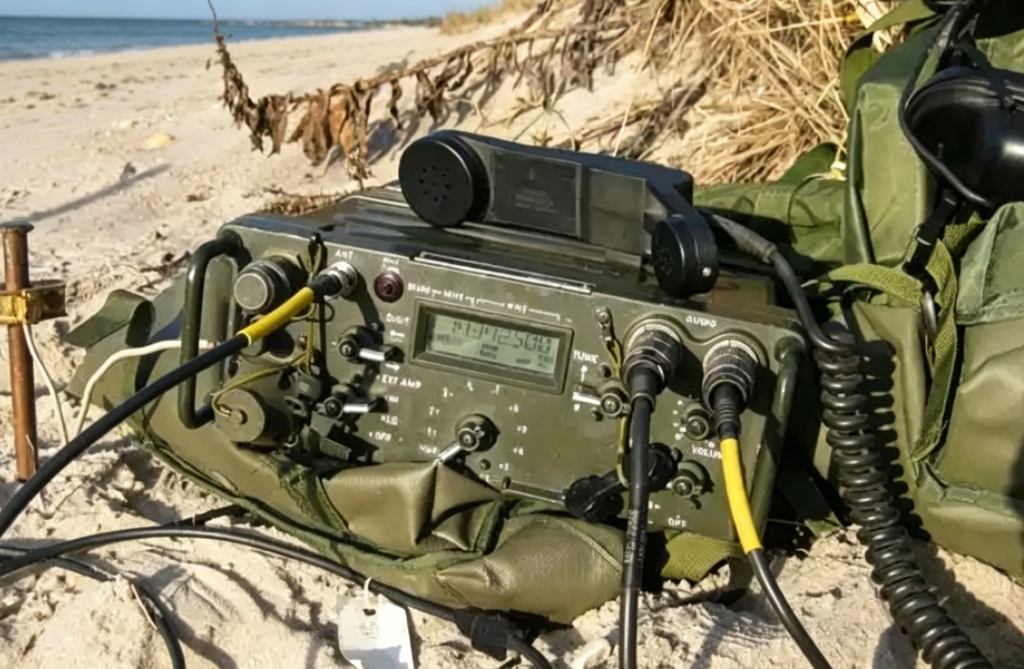
On the battlefield, every second counts. When a soldier needs to replace a radio battery under fire, connect night vision equipment in darkness, or re-plug a data link amidst vibration, speed is survival. The three-point bayonet coupling design of MIL-C-26482 was born to answer this battlefield imperative.
This article breaks down why the 26482 bayonet coupling has become the “quick-connect classic” of military connectors from three dimensions: mechanical principle, operational experience, and battlefield advantages.
Mechanical Principle — Three Bayonet Pins, How Does One Twist Lock?
1.1 Core Structure: Three Pins + Three Ramps
The mechanical core of the 26482 bayonet coupling system consists of two parts:
Receptacle Side:
Three stainless steel bayonet pins, evenly distributed around the circumference of the receptacle shell, spaced 120° apart
Plug Side:
Three ramps machined into the inner surface of the coupling ring
Each ramp terminates in a locking detent
When the plug is inserted into the receptacle, the three bayonet pins enter the openings of the three ramps respectively. At this point, the operator simply rotates the coupling ring clockwise approximately one-third of a turn (about 120°), and the pins slide along the ramps until they seat into the locking detents at the end.
1.2 Spring Preload: The “Anti-Loosening” Secret of the Wave Washer
Locking is not the end — staying locked is the key. The 26482’s coupling ring contains a wave washer.
Once the bayonet pins seat into the locking detents, the wave washer continuously applies axial tension, pushing the coupling ring forward and keeping the pins pressed firmly against the bottom of the detents. This preload ensures:
No self-loosening under severe vibration
The interfacial seal remains continuously compressed, maintaining waterproof sealing
1.3 Polarization Anti-Misinsertion: The Five-Key/Keyway System
When multiple connectors of the same shell size are installed on the same panel, the risk of misinsertion is extremely high. The 26482 solves this through a five-key/keyway polarization system.
The receptacle features five keyways, and the plug’s coupling ring has five corresponding keys. By varying the relative positions (rotation angles) of keys and keyways, multiple polarization configurations can be derived from the same shell size. Only a plug and receptacle with perfectly matched keying can mate — The inability to insert serves as the most intuitive error-proofing signal.
Triple Feedback — How to Confirm “Locked” in the Dark?
On the battlefield, soldiers often cannot visually confirm whether a connection is fully mated. The 26482’s bayonet coupling system provides three independent feedback mechanisms.
Auditory Feedback:
The moment the bayonet pins snap into the locking detents, the wave washer releases tension and the coupling ring emits a clear, loud “click”. Even amidst the noise of gunfire and engines, this sound can be heard.
Tactile Feedback:
Along with the “click,” the operator’s fingers can feel a slight vibration of the coupling ring and the sensation of locking into place. This tactile confirmation remains effective even when wearing tactical gloves — fingers can sense that “snap” moment.
Visual Feedback:
The coupling ring features inspection holes. When fully locked, the bayonet pins can be seen through these holes in their locked position. This provides a third level of confirmation in daylight or well-lit conditions.
The design logic of triple feedback is clear: in the dark, listen and feel; in the light, look — no matter the battlefield conditions, soldiers always have a way to confirm the connection is locked.
Battlefield Advantages — Speed, Reliability, One-Hand Operation
3.1 Speed: One-Third Turn vs Four Turns
Threaded coupling requires four full turns to lock. The 26482’s bayonet coupling requires only one-third of a turn.
On the battlefield, this difference means: threaded connectors require 5-10 seconds of operation, while bayonet connectors need only 1-2 seconds.
This speed advantage is particularly critical in the following scenarios:
Replacing damaged Line Replaceable Units (LRUs) under fire
Blind-mating night vision equipment in the dark
Reconnecting cables loosened by vibration while on the move
3.2 One-Hand Operation — Leave the Other Hand for the Weapon
Threaded coupling requires two hands — one to hold the receptacle, the other to rotate the plug. On the battlefield, this means the soldier must put down their weapon or abandon situational awareness.
The bayonet coupling of Series 26482 enables full one-handed operation: grip the plug with one hand, then rotate the coupling ring one-third of a turn using your thumb and index finger to lock it. Your other hand remains free to maintain control of the weapon or monitor surrounding situational awareness.
3.3 Vibration Resistance and Anti-Loosening — The Battlefield Value of the Wave Washer
The high-frequency vibration of fighters and helicopters, the low-frequency jolts of tanks, the constant motion of shipboard equipment — vibration is the number one killer of connectors on military platforms.
The wave washer preload design of the 26482 ensures that the bayonet pins remain constantly pressed into the locking detents. Even under extreme vibration, the connector will not self-loosen.
3.4 No Tools Required — “Plug and Play” for Battlefield Maintenance
Threaded connectors in some applications require lockwire to prevent loosening — requiring specialized tools and extra time. The 26482’s bayonet coupling requires no lockwire — the wave washer preload is already sufficient for vibration resistance and anti-loosening.
This means frontline soldiers can mate, unmate, and replace connectors without any tools — true “plug and play.”
Bayonet vs Threaded — Why Bayonet Wins on the Battlefield?
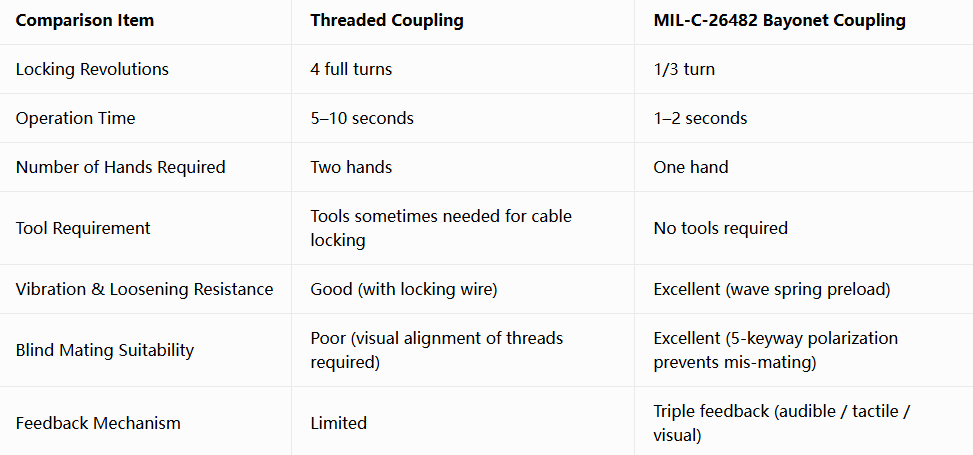
Speed means survival on the battlefield. The MIL-C-26482 bayonet coupling outperforms threaded designs across four key metrics: operational speed, single-handed ergonomics, tool-free operation and multi-sensory feedback — this is why it has become the iconic quick-disconnect connector for military applications.

Since its debut in the 1950s, the three-point bayonet coupling design of MIL-C-26482 has been in service for more than half a century. Its mechanical principle is straightforward: three locking pins, three inclined grooves, one wave spring, and five keyways. Yet the combination of these simple components delivers a fast, reliable, tool-free connection solution built for battlefield use.
A one-third turn, a crisp click, and a tool-free connection — this is the engineering elegance of the MIL-C-26482 bayonet coupling. On unseen battlefields, its sharp clicking sounds safeguard the success of every mission.
Recent Posta
Field Maintenance of M83513: How to Quickly Replace Contacts? Our

38999 vs MIL-C-83513: Circular vs Micro-Rectangular Our Products Two Shapes,

Salt Spray Resistance of MIL-C-26482: A Complete Guide to Plating
Get Quote of Connectors